





 Others were convinced that Jesus was God:
I'm grateful to commenter Edson for reminding me to return to a subject
to which I promised to return, namely the question of whether Jesus ever
claimed to be God.
I mainly want to invite discussion of the
subject, but I will try to note a few key points first about the use of
evidence from the Gospel of John in relation to this topic. First, the
uniform style of the Gospel of John and its distinctiveness in language
and style, as well as in its claims to Jesus' awareness of having
pre-existed in heaven, set John apart from the other three Gospels in
the New Testament, and because of this most historians do not feel that
they can attribute most of the words placed on the lips of Jesus in John
to the historical figure of Jesus. (It should also be remembered that
claiming pre-existence does not, without further evidence, equal a claim to divinity. The concept of a pre-existent Messiah can be found in the Similitudes of Enoch, with which the author of this Gospel seems to have been familiar).
Second, the use of the absolute "I AM" must be counterbalanced (as C. K. Barrett famously pointed out) with the emphasis (in the immediate context of Jesus' use of that language in chapter 8, for instance) on Jesus doing only what he is told, only what he sees the Father do. The name of God is explicitly said to have been given to Jesus in John 17:12, not long before which Jesus is depicted as calling the Father the only true God (whence the title of my book).
All in all, it must be seriously considered whether the depiction in
John is of Jesus as a figure like the angel Yahoel in the Apocalypse of Abraham, one who serves as God's supreme agent and is given the divine name in order to make clear that his authority - but not his identity - is that of God himself.
Finally,
even if we found Jesus making unqualified statements that he himself is
God, we should remember that similar claims are found in Deutero-Isaiah.
Yet there, no one has seriously suggested that the prophet is claiming
to be the only deity and to be God himself. There it is considered
obvious that the prophet is speaking in the divine first-person, and
that the "I of God" is not being confused with the "I of the prophet".
Insufficient attention is often given to the question of whether Jesus
is in certain instances best viewed as a prophet speaking in divine
first-person.
Before closing, I should mention that Brian LePort has shared some videos (featuring Jeff Louie) on his blog near emmaus.
One of them is relevant to this subject, but it is worth noting that it
focuses on a number of types of indirect evidence and theological
arguments, rather than on what Jesus may or may not have claimed about
himself. It also needs to be mentioned that there are a significant
number of Christians who have sought to reconcile the Gospel evidence
with their creedal tradition by claiming that Jesus was God but did not necessarily know he was God while on earth. And so the question of whether Jesus was God is not precisely the same as the question of whether he made such a claim about himself. And of course, it is also possible to conclude that Jesus believed himself to be God but was mistaken about this. And so I'd like to keep the focus here not on who Jesus was but what Jesus claimed. One subject at a time!
But that's all just by way of introduction. What do you think? Did Jesus ever claim to be God?
 | ||||
|  | Jesus is God | - Biblical Proof | |
| ||||
|  | | ||||||||||||||||||||||||||||||||||||||||||||||||||||||||||||||||||||||||||||||||||||||||||||||||||||||||||||||||||||||||||||||||||||||||||||||||||||||||||||||||||
| | You are here: Jesus Christ >> Jesus is GodJesus is God – What does the Bible say about Jesus’ deity? Jesus is God – Prophecies
Jesus is God – His Earthly Ministry
1 The bold emphases in verses is added by the author. Like this information? Help us by sharing it with others using the social media buttons below. What is this? Share Us: Follow Us:     | |
| | | ||||||||||||||||||||||||||||||||||||||||||||||||||||||||||||||||||||||||||||||||||||||||||||||||||||||||||||||||||||||||||||||||||||||||||||||||||||||||||||||
| |  | | |
| | What do you think? Which of the following best describes Jesus? Choose the best answer. 1-God 2-God-Like 3-Religious Leader and Teacher 4-Great Prophet 5-Myth | | |
|  | |
| | |
| Jesus Christ Home | About Us | Support Us | FAQ | FAQ 2 | FAQ 3 | Sitemap Copyright © 2002 - 2011 AllAboutJesusChrist.org, All Rights Reserved. | ||
|
God On The Net www.GodOnThe.net |
|---|
John 14:7-10 [7] If you really knew me, you would know my Father as well. From now on, you do know him and have seen him." [8] Philip said, "Lord, show us the Father and that will be enough for us." [9] Jesus answered: "Don't you know me, Philip, even after I have been among you such a long time? Anyone who has seen me has seen the Father. How can you say, `Show us the Father'? [10] Don't you believe that I am in the Father, and that the Father is in me? The words I say to you are not just my own. Rather, it is the Father, living in me, who is doing his work. John 10:30 "I and the Father are one." John 14:11 Believe me when I say that I am in the Father and the Father is in me; or at least believe on the evidence of the miracles themselves. John 10:37-38 [37] Do not believe me unless I do what my Father does. [38] But if I do it, even though you do not believe me, believe the miracles, that you may know and understand that the Father is in me, and I in the Father." Matthew 27:43 He trusts in God. Let God rescue him now if he wants him, for he said, 'I am the Son of God.'" John 17:11 I will remain in the world no longer, but they are still in the world, and I am coming to you. Holy Father, protect them by the power of your name--the name you gave me--so that they may be one as we are one.
Considering the overall content of the Bible, this cannot be: The Greek word he used, heis, is the word for the number one. It is a reference to the Shema, the core tenet of Judaism, "Sh'ma, Yisrael, Adonai Eloheynu Adonai echad," which, using Christian terminology is, "Hear, O Israel, Jehovah is our God. Jehovah is one." John 10:31-33 [31] Again the Jews picked up stones to stone him, [32] but Jesus said to them, "I have shown you many great miracles from the Father. For which of these do you stone me?" [33] "We are not stoning you for any of these," replied the Jews, "but for blasphemy, because you, a mere man, claim to be God." John 17:5 And now, Father, glorify me in your presence with the glory I had with you before the world began. John 17:10 [Speaking to the Father] All I have is yours, and all you have is mine. And glory has come to me through them.
Mark 14:61b-62 [61b] Again the high priest asked him, "Are you the Christ, the Son of the Blessed One?" [62] "I am," said Jesus. "And you will see the Son of Man sitting at the right hand of the Mighty One and coming on the clouds of heaven." Luke 22:66-70 [66] At daybreak the council of the elders of the people, both the chief priests and teachers of the law, met together, and Jesus was led before them. [67] "If you are the Christ, " they said, "tell us." Jesus answered, "If I tell you, you will not believe me, [68] and if I asked you, you would not answer. [69] But from now on, the Son of Man will be seated at the right hand of the mighty God." [70] They all asked, "Are you then the Son of God?" He replied, "You are right in saying I am." Daniel 7:13-14 [13] "In
my vision at night I looked, and there before me was one like a son
of man, coming with the clouds of heaven. He approached
the Ancient of Days and was led into his presence. [14] He was given
authority, glory and sovereign power; all peoples, nations and men of every
language worshiped him. His dominion is an everlasting dominion that will not
pass away, and his kingdom is one that will never be destroyed. Jesus clearly and repeatedly indicated that He is not the one who "calls the shots". John 14:31 the world must learn that I love the Father and that I do exactly what my Father has commanded me. John 7:16 Jesus answered, "My teaching is not my own. It comes from him who sent me." John 8:42 Jesus said to them, "If God were your Father, you would love me, for I came from God and now am here. I have not come on my own; but he sent me." John 17:3-12 [3] Now
this is eternal life: that they may know you, the only true God, and Jesus Christ,
whom you have sent. [4] I have brought you glory on earth
by completing the work you gave me to do. [5] And now, Father,
glorify me in your presence with the glory I had with you before
the world began. [6] I have revealed you to those whom you gave me out
of the world. They were yours; you gave them to me and they have
obeyed your word. [7] Now they know that everything you have given
me comes from you. [8] For I gave them the words you gave
me and they accepted them. They knew with certainty that I came
from you, and they believed that you sent me. [9] I
pray for them. I am not praying for the world, but for those you have
given me, for they are yours. [10] All I have is yours, and
all you have is mine. And glory has come to me through them. [11] I
will remain in the world no longer, but they are still in the world, and I am
coming to you. Holy Father, protect them by the power of your name--the
name you gave me--so that they may be one as we are one. [12] While
I was with them, I protected them and kept them safe by that name you
gave me. None has been lost except the one doomed to destruction so
that Scripture would be fulfilled. The Hebrew Bible
From The
Tanakh -- The New JPS Translation
Proverbs 30:4 [NKJV] Who has ascended into heaven, or descended? Who has gathered the wind in His fists? Who has bound the waters in a garment? Who has established all the ends of the earth? What is His name, and what is His Son's name, if you know?
Isaiah 9:6-7 [6] For to us a child is born, to us a son is given, and the government will be on his shoulders. And he will be called Wonderful Counselor, Mighty God, Everlasting Father, Prince of Peace. [7] Of the increase of his government and peace there will be no end. He will reign on David's throne and over his kingdom, establishing and upholding it with justice and righteousness from that time on and forever. ...
This is known as The Trilemma.
(c) 1998, 2007 by Rick Reinckens
WhatTheBibleTeaches.com HubbleSpacePhotos.com RomanCatholicTeachings.com |
||||||||||||
A Series of Answers to Common Questions
Question:
Jesus says that the Father is greater than he is, proving that he is not God. There is no one who is greater than God.
Answer:
Here is the passage in question:
"You heard that I said to you, 'I go away, and I will come to you ' If you loved Me, you would have rejoiced because I go to the Father, for the Father is greater (meizon) than I." John 14:28
Since the questioner (a Muslim) assumes Unitarianism (that God is one in being and in Person), it obviously doesn't make sense for God to speak of someone being greater than himself. Yet, if God is a Trinity, a Trinitarian Being (i.e. one eternal God existing in three distinct, yet inseparable Persons), then it is quite possible for one member or Person of the Godhead to be greater in some sense than the other members. It would be true that nothing outside of the Holy Trinity's own existence could ever be greater, but this doesn't necessarily imply that there cannot be some type of authority structure or ranking within the internal life and relationships of the Trinity itself. Lord Jesus permitting, we will develop this point more in a future article.
For now, let us deal with what Jesus intended to convey to his disciples that the Father was greater than he. In the first place, the term for "greater" (Greek - meizon) does not necessarily imply one who is greater in nature or essence. It can refer to someone or something being greater in position and/or authority, just as the following passages show:
"I tell you the truth: Among those born of women there has not risen anyone greater (meizon) than John the Baptist; yet he who is least in the kingdom of heaven is greater than he." Matthew 11:11
John being greater than all those born of women does not imply that the rest were less human than John, or that they were inferior to John in nature. Here, the term must mean that John was greater in position and rank.
"Truly, truly, I say to you, a slave is not greater (meizon) than his master, nor is one who is sent greater (meizon) than the one who sent him." John 13:16
Both the slave and the one sent are just as human as the master and the sender, having the same human essence and nature that the master and sender have. Thus, greater here must mean in position and authority, not in essence and nature.
"I tell you the truth, anyone who has faith in me will do what I have been doing. He will do even greater (meizona) things than these, because I am going to the Father." John 14:12
Jesus' disciples did not perform better works, but performed a greater number of works than Christ since they reached far more people than Jesus did while he was on earth. Hence, the term "greater" refers to quantity, the amount of works, as opposed to quality since the disciples performed the same type of works but in far greater number.
The preceding data shows that the word meizon can either mean, depending upon the context, greater in nature, position, or even both. Thus, the only way we can know for certain what Jesus meant by saying that the Father was greater than him is by reading his statement in its immediate context. A careful look at the entire chapter of 14 shows the Lord Jesus claiming to have all of God's omni-attributes:
"And I WILL DO whatever you ask IN MY NAME, so that the Son may bring glory to the Father. You may ask ME for anything in my name, AND I WILL DO IT." John 14:13-14
Christ is capable of personally answering all prayers that are directed to him or are addressed in his name. The only way that Christ can both hear and answer all these prayers is if he is both omniscient and omnipotent!
"On that day you will realize that I am in my Father, and you are in me, AND I AM IN YOU. Whoever has my commands and obeys them, he is the one who loves me. He who loves me will be loved by my Father, and I too will love him and show myself to him." John 14:20-21
Christ says that he is IN all the disciples, an impossible claim if he was only a man, or even an angel. But since Jesus is God, and since God is omnipresent, it therefore makes perfect sense for Christ to say he is able to dwell in all the believers at the same time.
Finally:
"Jesus replied, ‘If anyone loves me, he will obey my teaching. My Father will love him, and WE will come to him and make OUR home with him.’" John 14:23
Both the Father and the Son make their home with all true believers! Christ is clearly claiming co-equality with the Father since he is present with every believer in the same way that the Father is!
In fact, even those who heard Jesus knew that he was claiming to be equal to his Father:
"And this was why the Jews persecuted Jesus, because he did this on the sabbath. But Jesus answered them, ‘My Father is working still, AND I AM WORKING.’ This was why the Jews sought all the more to kill him, because he not only broke the sabbath but also called God his Father, making himself equal (ison) with God." John 5:16-18
The reason why the Jews thought that Jesus was claiming equality with God is because of his bold assertion that he has the same divine right to work on the Sabbath as his Father does, being his Son. Jesus was pretty much saying that, as God’s Son, he could do things which were considered unlawful on this sacred day since he is not bound by the laws and regulations of the Sabbath in the same way that God isn’t bound by them.
The following is another example of Jesus claiming to be equal with the Father:
“‘My sheep listen to my voice; I know them, and they follow me. I give them eternal life, and they shall never perish; no one can snatch them out of my hand. My Father, who has given them to me, is greater than all; no one can snatch them out of my Father's hand. I and the Father are one.’ Again the Jews picked up stones to stone him, but Jesus said to them, ‘I have shown you many great miracles from the Father. For which of these do you stone me?’ ‘We are not stoning you for any of these,’ replied the Jews, ‘but for blasphemy, because you, a mere man, claim to be God.’” John 10:27-33
Christ ascribes to himself the very exclusive prerogatives of Deity:
“See now that I myself am He! There is no god besides me. I put to death and I bring to life, I have wounded and I will heal, and no one can deliver out of my hand.” Deuteronomy 32:39
“Yes, and from ancient days I am he. No one can deliver out of my hand. When I act, who can reverse it?” Isaiah 43:13
As if this weren’t astonishing enough, Jesus says that he is one with the Father right after stating that the latter is greater than all, which in the context refers to those who would try to pluck believers from the Father’s all-powerful hand.
To more fully appreciate the implications of these statements, keep in mind that Jesus’ point is that there is no person who can prevent God from protecting his flock since there is no being that is as powerful as God who can thereby thwart his purposes in saving his sheep. Yet the Lord Jesus places himself in a unique position and category since he actually believes that he is his Father’s equal, being one with him in ability and power which is completely unlike anyone else!
No wonder the Jews thought that Jesus was blaspheming. They could clearly see that Christ was claiming to be God for believing that he could do things which only Yahweh could do and for actually thinking that he was just as powerful as the Father!
In light of the foregoing, it is quite clear what the Lord Jesus meant that the Father was greater than him. The Scriptures teach that when Christ became a man, he assumed the role and position of a slave/servant:
"For who is the greater, one who reclines at table or one who serves? Is it not the one who reclines at table? But I am among you as the one who serves." Luke 22:27
"Jesus, knowing that the Father had given all things into his hands, and that he had come from God and was going back to God, rose from supper. He laid aside his outer garments, and taking a towel, tied it around his waist. Then he poured water into a basin and began to wash the disciples' feet and to wipe them with the towel that was wrapped around him. He came to Simon Peter, who said to him, 'Lord, do you wash my feet?' Jesus answered him, 'What I am doing you do not understand now, but afterward you will understand.' Peter said to him, 'You shall never wash my feet." Jesus answered him, 'If I do not wash you, you have no share with me.' Simon Peter said to him, 'Lord, not my feet only but also my hands and my head!' Jesus said to him, 'The one who has bathed does not need to wash, except for his feet, but is completely clean. And you are clean, but not every one of you.' For he knew who was to betray him; that was why he said, 'Not all of you are clean.' When he had washed their feet and put on his outer garments and resumed his place, he said to them, 'Do you understand what I have done to you? You call me Teacher and Lord, and you are right, for so I am. If I then, your Lord and Teacher, have washed your feet, you also ought to wash one another's feet. For I have given you an example, that you also should do just as I have done to you.'" John 13:3-15
"Have this mind among yourselves, which is yours in Christ Jesus, who, though he was in the form of God, did not count equality with God a thing to be grasped, but made himself nothing, taking the form of a servant, being born in the likeness of men. And being found in human form, he humbled himself by becoming obedient to the point of death, even death on a cross." Philippians 2:5-8
Thus, as long as Christ remained on earth in the form and position of a humble slave, enduring persecution, insults, injury, and subsequently the shame of the cross, the Father would be greater in position and honor. Once Christ returns to heaven to be seated alongside his Father, he would no longer be in that state of humiliation. He would share, once again, that same divine glory and sovereign authority that he had with the Father before he had come to the earth as a man:
"Now, Father, glorify Me together with Yourself, with the glory which I had with You before the world was... Father, I desire that they also, whom You have given Me, be with Me where I am, so that they may see My glory which You have given Me, for You loved Me before the foundation of the world." John 17:5, 24
Thus, the Father was greater in position and rank, not in essence and nature. The questioner is, therefore, committing a categorical fallacy. He/she is confusing the category of position and rank with the category of essence and nature, erroneously assuming that if one is greater in one way, i.e. position and authority, than he/she must be greater in every way, i.e. essence and nature. In light of these clear biblical truths, such is not the case at all.
A Series of Answers to Common Questions
Answering Islam Home Page


About
Crucial ?'s
FAQ1
FAQ2
Tools
Bookstore
|
||||||||
| ||||||||
 | ||||||||
 © Copyright 2002-2011 Got Questions Ministries - All Rights Reserved. www.gotquestions.org - Bible Questions Answered - Site Map |

Follow us


Did Jesus claim to be God?
Many are willing to accept Jesus Christ as a good man, or a great prophet, but argue that Jesus never claimed to be God. Those who deny Jesus’ deity point out scriptures that back up their belief that Jesus never intended to be worshipped as God.
The evidence, however, indicates that from the time of the apostles, Jesus was worshipped as Lord. After the apostles died, several first and second century church leaders wrote of Jesus’ deity. Finally in 325 A. D. the leadership of the church articulated the belief that Jesus is fully God.
Some argue that the church “invented” Jesus’ deity by rewriting the gospel accounts. In fact, the world’s best-selling fictional book, The Da Vinci Code sold over 40 million books by making that claim (See “Was there a Da Vinci Conspiracy?”). Although the book made its author, Dan Brown, wealthy, his fictional account was debunked by scholars as bad history. In fact, the New Testament has been deemed the “most reliable of all ancient historical documents” (See. “Are the Gospels True?”).
In this article we will examine what Jesus Christ said about himself. What did Jesus mean by the terms, “Son of Man,” and “Son of God?” If Jesus wasn’t God, why did his enemies accuse him of “blasphemy?” More importantly, if Jesus wasn’t God, why did he accept worship?
First let’s look briefly at what Christians believe about Jesus Christ.
From Creator to Carpenter?
At the core of Christianity is the belief that God came to earth in the Person of His Son, Jesus Christ. The Bible teaches that Jesus is not a created being like the angels, but is the very Creator of the universe. As theologian J. I. Packer writes, “The gospel tells us that our Creator has become our Redeemer.”2
The New Testament reveals that, in accordance with his Father’s will, Jesus temporarily set aside his power and glory to become a tiny helpless baby. As he grew, Jesus worked in a carpenter shop, experienced hunger, got tired, and suffered pain and death like us. Then at age 30 he began his public ministry.
Click here to continue reading "Did Jesus claim to be God?"

Did Jesus Ever Say He was God?Jesus quotes - is Jesus God? Investigate these interesting claims...
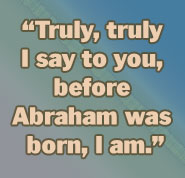
But what did Jesus say about himself? Did he ever identify himself as God? According to the Bible...absolutely! Below are some of his statements made while on earth, in their context. Is Jesus God? Jesus quotes: He said he was equal to God..."Your father Abraham rejoiced as he looked forward to my coming. He saw it and was glad." The people said, "You aren't even fifty years old. How can you say you have seen Abraham?" Jesus answered, "I tell you the truth, before Abraham was even born, I Am!" At that point they picked up stones to throw at him. But Jesus was hidden from them and left the Temple.4 "The Father and I are one." Once again the people picked up stones to kill him. Jesus said, "At my Father's direction I have done many good works. For which one are you going to stone me?" They replied, "We're stoning you not for any good work, but for blasphemy! You, a mere man, claim to be God."5 Jesus shouted to the crowds, "If you trust me, you are trusting not only me, but also God who sent me. For when you see me, you are seeing the one who sent me. I have come as a light to shine in this dark world, so that all who put their trust in me will no longer remain in the dark."6 After washing their feet, he put on his robe again and sat down and asked, "Do you understand what I was doing? You call me 'Teacher' and 'Lord,' and you are right, because that's what I am. And since I, your Lord and Teacher, have washed your feet, you ought to wash each other's feet."7 Jesus told him, "I am the way, the truth, and the life. No one can come to the Father except through me. If you had really known me, you would know who my Father is. From now on, you do know him and have seen him!" Philip said, "Lord, show us the Father, and we will be satisfied." Jesus replied, "Have I been with you all this time, Philip, and yet you still don't know who I am? Anyone who has seen me has seen the Father! So why are you asking me to show him to you?"8 Is Jesus God? Jesus quotes: How he described himself...Jesus said, "I tell you the truth, Moses didn't give you bread from heaven. My Father did. And now he offers you the true bread from heaven. The true bread of God is the one who comes down from heaven and gives life to the world." "Sir," they said, "give us that bread every day." Jesus replied, "I am the bread of life. Whoever comes to me will never be hungry again. Whoever believes in me will never be thirsty."9 Jesus spoke to the people once more and said, "I am the light of the world. If you follow me, you won't have to walk in darkness, because you will have the light that leads to life." The Pharisees replied, "You are making those claims about yourself! Such testimony is not valid." Jesus told them, "These claims are valid even though I make them about myself. For I know where I came from and where I am going, but you don't know this about me."10 so he explained it to them: "I tell you the truth, I am the gate for the sheep. All who came before me were thieves and robbers. But the true sheep did not listen to them. Yes, I am the gate. Those who come in through me will be saved. They will come and go freely and will find good pastures. The thief's purpose is to steal and kill and destroy. My purpose is to give them a rich and satisfying life. I am the good shepherd. The good shepherd sacrifices his life for the sheep."11 Martha said to Jesus, "Lord, if only you had been here, my brother would not have died. But even now I know that God will give you whatever you ask." Jesus told her, "Your brother will rise again." "Yes," Martha said, "he will rise when everyone else rises, at the last day." Jesus told her, "I am the resurrection and the life. Anyone who believes in me will live, even after dying. Everyone who lives in me and believes in me will never ever die. Do you believe this, Martha?" "Yes, Lord," she told him. "I have always believed you are the Messiah, the Son of God, the one who has come into the world from God."12 Is Jesus God? Jesus quotes: What he said he was sent here to do...But Jesus called them together and said, "You know that the rulers in this world lord it over their people, and officials flaunt their authority over those under them. But among you it will be different. Whoever wants to be a leader among you must be your servant, and whoever wants to be first among you must become your slave. For even the Son of Man came not to be served but to serve others and to give his life as a ransom for many."13 for he wanted to spend more time with his disciples and teach them. He said to them, "The Son of Man is going to be betrayed into the hands of his enemies. He will be killed, but three days later he will rise from the dead." They didn't understand what he was saying, however, and they were afraid to ask him what he meant.14 "For God loved the world so much that he gave his one and only Son, so that everyone who believes in him will not perish but have eternal life. God sent his Son into the world not to judge the world, but to save the world through him. There is no judgment against anyone who believes in him. But anyone who does not believe in him has already been judged for not believing in God's one and only Son."15 However, those the Father has given me will come to me, and I will never reject them. For I have come down from heaven to do the will of God who sent me, not to do my own will. And this is the will of God, that I should not lose even one of all those he has given me, but that I should raise them up at the last day. For it is my Father's will that all who see his Son and believe in him should have eternal life. I will raise them up at the last day."16 Still wondering if Jesus is God? Please see the following evidence presented in this article: Beyond Blind Faith.
(1) Col 1:15
=======================================================================================================  Honest Answers To Tough QuestionsWhere did Jesus claim to be God?In Matthew 12:6, Jesus says to the Pharisees, "I say to you, that something greater than the Temple is here." How much greater? Look at verse 8. Referring to Himself, Jesus asserts, "The Son of Man is Lord of the Sabbath." How can anyone be Lord of the Sabbath except God who instituted it? This is a direct claim to deity. In Matthew 23:37, Jesus speaks as though He has personally observed the whole history of Jerusalem: 0 Jerusalem, Jerusalem, who kills the prophets and stones those who are sent to her! How often I wanted to gather your children together, the way a hen gathers her chicks under her wings, and you were unwilling. In Mark 2:1,2, Jesus tells a paralyzed man, "My son, your sins are forgiven." Some scribes sitting there caught the obvious intent of Jesus' words and reasoned: Why does this man speak in this way? He is blaspheming; who can forgive sins but God alone? Jesus challenged them: Which is easier, to say to the paralytic, "Your sins are forgiven"; or to say, "Arise, and take up your pallet and walk"? But in order that you may know that the Son of Man has authority on earth to forgive sins ... And then Jesus healed the paralytic. The implication was obvious. No one forgives sin but God. Anyone could say he is able to forgive sin; but Jesus proved He had the authority to forgive sin when He healed the paralytic. Jesus was clearly claiming deity for Himself. Back again in Matthew, at the end of the Sermon on the Mount (7:21-23), Jesus speaks of Himself as the ultimate judge who will have authority to deny entrance into the kingdom of heaven. In the next paragraph, rather than say, "Everyone who hears the words of God or Torah will lay a strong foundation for their lives," Jesus states, "Everyone who hears these words of mine . . . " David Biven, a researcher of the Hebraic background of the Gospel accounts, concludes: "It was not the way He taught or even the general content of His teaching that made Jesus unique among the rabbis. What was unique about Jesus was who He claimed to be, and He rarely ever taught without claiming to be not only God's Messiah, but more startlingly, Immanuel, "God with us."" It is surprising how critics try to reject Jesus' constant references to Himself as deity. Ian Wilson, for example, writes: "In the Mark Gospel, the most consistent in conveying Jesus' humanity, a man is represented as running up to Jesus and addressing Him with the words "Good Master." Jesus' response is a firm rebuke: "Why do you call me good? No one is good but God alone" (Mark 10:18)." Wilson's interpretation is 180 degrees in the wrong direction. Seen within the context of the situation, Jesus is using obvious irony. In essence, He is arguing: (1) If no one is good but God alone, and (2) if I am good, then (3) I must be God. Often Jesus receives worship and does nothing to discourage it (see Matthew 14:33, John 9:38). You would think the one who severely rebukes Peter for trying to keep Him from God's will of being crucified would also severely rebuke someone offering worship to Him [which rightly ought to be given only to the one true living God.] The Apostle Paul severely reacted against being deified at Lystra (Acts 14:8-18). How much more should Jesus have reacted if He were only a mere man? Did He not quote Deuteronomy 6:13 to Satan during His temptation, "You shall worship the Lord your God, and serve Him only"? One notable occurrence of Jesus accepting worship is in Matthew 21:15,16. Children cried out, "Hosanna to the Son of David," in praise to Jesus. "Hosanna" is used here as a cry of adoration, but some critics insist on interpreting "Hosanna" in a stiffly literal sense, rendering the statement "Save us Son of David." This interpretation cannot be accurate, though, because (1) it would actually then read: "Save us to the Son of David," which makes little or no sense; (2) the chief priests and scribes who saw Jesus receiving the praise "became indignant and said to Him, 'Do you hear what these are saying?' " as though Jesus should have silenced the crowd (something He would be expected to do only if the crowd were worshipping Him); and most important, (3) Jesus replied by attributing to Himself something which was meant for God alone. He asked the chief priests and scribes, "Have you never read, 'Out of the mouth of infants and nursing babes Thou [God] hast prepared praise for Thyself [God]'?" Did you catch what Jesus said? Basically it was, "When those children praise me, they are praising God." Of all the Gospel writers, John most clearly perceived the cues Jesus gave about His identity. For his effort to report those cues, he has been the most criticized Gospel writer of all, allegedly falling under Hellenistic influence. Scholars today, however, have begun to realize the inaccuracy of this charge. In John 8:58, when Jesus proclaimed to a Jewish crowd, "Truly, truly I say to you, before Abraham was born, I Am," He was claiming two aspects of deity for Himself; the eternal existence of God and the name of God. Jesus was referring His listeners back to Exodus 3:13,14 where Moses tells God: Behold, I am going to the sons of Israel, and I shall say to them, "The God of your fathers has sent me to you." Now they may say to me, "What is His name?" What shall I say to them? God answered Moses, I AM WHO I AM ... Thus you shall say to the sons of Israel, "I AM has sent me to you." Any Jewish person would have heard Jesus' claim to deity loud and clear. That is why the very next verse in John's account states: "Therefore they picked up stones to throw at Him" (John 8:59). In all, Jesus uses the term "I am" (Gr. Ego eimi) more than nineteen times in reference to Himself in the Gospel according to John. Often it is used to make claims about Himself that normally would be thought appropriate only for God. For example, I am the bread of life, he who comes to Me shall not hunger, and he who believes in Me shall never thirst (6:35); I am the light of the world; he who follows Me shall not walk in the darkness, but shall have the light of life (8:12); Unless you believe that I am He, you shall die in your sins (8:24); I am the good shepherd (10:11-14) [cf. Psalm 23:1: "The LORD is my shepherd"]; I am the resurrection, and the life; He who believes in Me shall live even if he dies (11:25). Other Scriptures on this subject include John 4:26; 6:41,48,51; 8:18, 28,58; 10:7,9; 13:19; 14:6; and 15:1.) Earlier, in John 5:17, Jesus claimed to be continuing the work of the Father. He also called God "My Father." In John 10:28-30 Jesus again called God "My Father." He also claimed at one time to be the giver of eternal life and at another time to be one with the Father. On both those occasions, the Jewish crowds picked up stones to stone Him because, as they put it, "You, being a man, make Yourself out to be God" (John 10:33; cf. 5:18). In John 14:6, Jesus did not just claim to be teaching mankind the truth; He claimed that He was the truth. In John 14:9, Jesus admonished Philip, "He who has seen Me has seen the Father." In Isaiah 42:8, God said, "I am the LORD, that is My name; I will not give My glory to another." But in John 17:5, Jesus prayed, "And now, glorify Thou Me together with Thyself, Father, with the glory which I ever had with Thee before the world was." In John 5:19ff., Jesus delivers a long monologue in which He makes repeated claims to be on the same level of authority as God the Father. "Even in His parables," says Norman Geisler, "Jesus claimed functions reserved only for Yahweh in the Old Testament, such as being Shepherd (Luke 15), Rock (Matthew 7:24-27), and Sower (Matthew 13:24-30)." 31/14 C. S. Lewis, in his book Mere Christianity, puts all these claims in the right perspective when he reminds his readers that Jesus was a Jew among Jews: "Among these Jews there suddenly turns up a man who goes about talking as if He was God. He claims to forgive sins. He says He has always existed. He says He is coming to judge the world at the end of time. Now let us get this clear. Among pantheists, like the Indians, anyone might say that he was a part of God, or one with God: there would be nothing very odd about it. But this man, since He was a Jew, could not mean that kind of God. God, in their language, meant the Being outside the world who had made it and was infinitely different from anything else. And when you have grasped that, you will see that what this man said was, quite simply, the most shocking thing that has ever been uttered by human lips." The question is, can we accept as true what Jesus [God the Son], claimed? The most conclusive evidence establishing the deity of Christ is the historically verifiable resurrection. The apostle Paul wrote that Jesus "was declared with power to be the Son of God by the resurrection from the dead." (Romans 1:4) If the resurrection of Christ is true, then it is possible and, indeed, logical to believe all His claims and miracles including His assertion of the complete validity of the Old Testament. They would be what one would expect from God. The primary reason that Jesus is the only way to God is that He forgives sin and offers eternal life, (John 10:28) something that the founder of no other major religion has claimed to do. Think about that! Every person is separated from a perfect, holy God by sin. According to God’s requirement, either the individual must pay the penalty for sin – death – or he must find someone who is willing and able – who has no sin – to pay the penalty for him. (Hebrews 9:14, 22) Jesus Christ was both able and willing to do this, as demonstrated by His death on the cross. That is why Jesus is the only way to God. For a more in-depth review of this important subject, go to claims. Will you receive Jesus Christ as Savior, and choose to follow Him today? Would you like to know God personally IF you have questions click here. Top of page | Back to Questions Index © 2007-2008 Global Media Outreach. All rights reserved. | Terms | Privacy | Contact | Link to us ========================================================================== |





Translate This Page

59 comments:
Not only did Jesus claim to be "God," but he went a step further and claimed to be the "I AM" (ego eimi) in John 8:58: "before Abraham was, I AM." Of course this covenant name comes from Exodus 3:14 and is listed as God's memorial name for all generations.
Also of note is John 10:30 where He says, "I and My Father are one." The response of the Jews is very telling: "For a good work we do not stone You, but for blasphemy, and because You, being a Man, make Yourself God" (10:33). It is evident that the Jews believed that He was claiming to be God.
Warm regards, Jonathan
I think I have touched on this in various conversations here which have never completely focused on this question, but have been tangential points.
If, for argument's sake, we don't rely on the gospel of John and are merely considering Matthew, Mark and Luke we don't have clear, blatant claims to Jesus' Divinity...such as Jesus saying,"I am God...I am part of God...I am a son of God in a way that no other person is a child of God."
However...I think a very strong case can be made that the synoptic gospels portray Jesus as divine in a way that other humans were not. I think one could go further and say that Jesus' claims to authority, the power to forgive sins, the power to establish a "New Covenant", and the power to relativize certain aspects of the Mosaic code are all indicators pointing to his divinity and his own self-understanding of his divinity.
I made this point in some other conversation....the portrayal of Jesus is unique. He is not portrayed as a prophet receiving a message to deliver. He is not portrayed as a Moses-like figure or even an Elijah/Elisha-like miracle worker. The flavor of the gospel narratives is completely different than any other narratives we have in the Old Testament.
Jesus acts not as an agent of God....but as one with the ability and power to remake or recast one's understanding of God and what God required of humans.
I think it can be argued that early Christians believed that Jesus was God and that the gospel writers surely tried to portray that idea in their narratives.
James...I followed that link about deutero-Isaiah and it wasn't clear to me that any of the I AM statements were being portrayed as the words of Isaiah himself. Am I misunderstanding/misreading something?
Jonathan, it would help if you actually engaged what I said in the blog post itself about the divine name, rather than ignoring it. Otherwise, we're not likely to be able to engage in conversation.
As for the blasphemy accusation, it is worth asking whether the author of the Gospel thought Jesus was "guilty as charged". In John 5, Jesus is made to respond to and seemingly deny that he is "making himself" anything. In John 10, appeal is made to a psalm that uses "god" in a broader way not unknown in the Judaism of this time.
Terri, thanks for your comment. My point was simply that the words in the second part of Isaiah are of course penned or authored by the person who composed that section. But because it is in the prophetic books, we assume that when the person speaks in the first person as God, this is prophetic speech rather than a claim to divinity. My question is whether, given that "prophet" is one of the ways Jesus is referred to in the Gospels and other early sources, we might not understand some of the language Jesus is depicted as using in the same way.
Thank you Prof. McGrath for posting this.
Prof. I think there are three levels of tackling the "did Jesus claim to be God" problem.
The first one is honesty (to approach the available sources neutrally without bias, I'll calrify about it soon), the second one is trust (do you believe in the authenticity of the available sources?) and the third one is interpretability (do you take a direct route depending on the context).
I have noticed you are a naturalist, one who do not believe in the supernatural or miracles and you already this seems to me to be a difficult part on your part on how to treat the available evidence without bias, but any way let us try.
There are common grounds between me and you about the matter. We all believe Jesus, a person, existed historically. We certainly agree on the New Testament document to be the most reliable document of antiquity. If not let me hear about it. Now let me throw the first shot.
Do you believe Jesus believed to be Christ (prophecied Messiah of Jews)? And if you do, how do you interprete Mattew 22:41-46?
Edson, I don't appreciate your caricature of my views. I've yet to hear an explanation of what historical study is if not an attempt to assess and evaluate the evidence that certain things did or did not happen. It doesn't involve simply trusting our sources, although one certainly may choose to give them the benefit of the doubt when the evidence is ambiguous. But that is not the same thing as approaching the sources uncritically and just "trusting" them.
Historical study, like the natural sciences, has to be methodologically naturalistic. A miracle is never going to be the most likely explanation for the presence of a story about miracles in an ancient source. It will always be more likely that the story is like most ancient miracle stories and reflects a widespread belief in miracles, rather than what actually happened. That doesn't disprove miracles or prove metaphysical naturalism. It just means that historical study can't give us proof of such occurrences in the past. Again, I don't think you'll find this to be controversial among historians.
Finally, your question about Matthew 22:41-46. The only point the riddle seems to make is about the superiority of the Messiah to David, and the apparent incompatibility of this with his status as son of David. Since this is also found in Mark 12:35-37, it is unlikely to reflect a belief in the virgin birth, but even if it did, that's obviously not the same thing as a claim to divinity, and so is besides the point.
A riddle to which we are not given the answer is an interesting choice of places to begin this discussion. Is this an indication that all "claims" to divinity that are to be found in the Synoptic Gospels are in fact "insinuations" of divinity? If so, might they be otherwise understood if one does not already assume what needs to be proved, namely that Jesus was claiming to be God?
At any rate, unless one thinks Jesus is denying the Davidic descent of the Messiah, then the question asks how one's descendant can also be one's lord. Obviously "because he's also God incarnate" is one possible answer to the riddle. Is it the only possible answer? Is it the most obvious one in the context? Did anything in Mark's Gospel up until this point prepare for it to be answered by the reader in this way?
James, I am sorry I didn't engage enough for you. The difficulties you mention are answered by understanding the basics of the hypostatic union of Christ. Jesus was fully God and fully man. His divinity did not diminish His humanity, and his humanity did not diminish His divinity.
Contra your statement on John 5, "Jesus is made to respond to and seemingly deny that he is 'making himself' anything," again, the Jews understood that He "said that God was His Father, making Himself equal with God" (5:18).
James, obviously we come to the text with two different presuppositions. I believe the text is God-breathed and you do not. You say, "Jesus is made to respond" in certain ways, which makes the NT a wax nose to suite the readers' opinion on who she wants God to be. I pray that your reconsider your opinion on the nature of the Scriptures.
Jonathan, thanks for your reply. I don't know anything about wax noses, so I can't really speak to that. But in order to get from "this source depicts X as saying" to "X said" as a statement of historical confidence, further steps and arguments are required. I'm afraid that's just how historical study works, and if we want to ask historical questions, I've yet to find other tools that will allow us to investigate them.
There's a very short article on John 5:18 that I published a while back, which may clarify my understanding of the text. But in brief, the accusation levelled against Jesus is that he is "making himself equal to God". The response that Jesus is depicted as offering has Jesus say that "the Son can do/make nothing of himself", using the same terminology as the accusation but denying it. It seems to be an argument that, far from a son doing what his father does being an inappropriate claim to the father's status, doing what one's father does is precisely what would be expected of an obedient son.
One last thing. I'm open to changing my view of the nature of Scripture. If you've read my blog at all, you'll know that I've done that before. All that is needed is a persuasive case explaining why the view I currently have is wrong and why another view is better!
Thanks, James. I'll try to read the article a bit later. I'm busy preparing a lecture on Gnosticism for tomorrow. Good times!
I had heard vague rumors about that liberal Jesus Seminar saying that Jesus did not claim to be God. But really, the Jesus Seminar? As I came to know more of what was actually in the Bible, I started maybe accepting the possibility.
Then I read Jesus Interrupted by the dreaded Bart Erhman in which he, yet again, urges me (yes, Me) to read each Gospel as it stands alone, without John to shore it up. I reread Matthew's gospel and, lo, in it Jesus never claims to be divine, only the Son of Man or Son of God (like David). I was almost tripped up when the disciples "worship" Jesus in the boat after he walks on water but a quick check found that the word translated as worship in the NRSV was probably better seen as meaning "prostrated themselves before."
So, now I am completely open to the view that Jesus did not see himself as divine. In fact I am approaching Adoptionism. I really curious about
whether Jesus' temptation following his baptism and God's famous, "today I have begotten thee" was presented as a test of Jesus' worthiness for his new position. If he were already God, and knew it, why would he need to be "tested."
That said, I am not quite ready to teach this lesson in Sunday School. :^0
I'll go with this. The direct nature of Jesus' response is not an insinuation.
“But he was silent and did not answer. Again the high priest asked him, “Are you the Messiah, the Son of the Blessed One?” Jesus said, “I am; and ‘you will see the Son of Man seated at the right hand of the Power,’ and ‘coming with the clouds of heaven.’””
(Mark 14:61–62 NRSV)
Prof. McGrath you are taking a long winded way of explaining the issues. Please be kind to make your point direct. It'll save my time to understand your point and your time too to write. And forgive me if I'm appearing caricaturing, It's not my intention, hope you understand.
Honestly, I didin't get anything substantial in your response. When you say "....it is unlikely to reflect a belief in the virgin birth, but even if it did, that's obviously not the same thing as a claim to divinity, and so is besides the point", what do you imply to mean?
We are not discussing about miracles here, or virgin birth or orthodox christianity doctrinal issues. We are attempting to figure out if we can get an impression in the bible or any other document that Jesus thought himself to be divine or not.
What I want to know from you in these verses that I gave is that do you get that impression, that Jesus thought himself to be a Messiah and Divine in nature? If you do not get it why?
Hope the lecture goes well. Back when I was teaching in Romania, I had students do some translating of articles from the Dictionary of Jesus and the Gospels, as an assignment that also had the potential to make some more materials available in Romanian. I remember one student whose English was fantastic, but nevertheless found that a knowledge of English was not enough to make sense of one particular expression: "the pan-Gnostic theory". Obviously (from your perspective and mine) "pan" there is from Greek rather than English. But the student did her best with it and offered as a translation "teoria gnosticului-tigaie" - which in English would be the "frying pan Gnostic theory". :)
Anyway, that's nothing to do with this thread, but I thought you might enjoy the story...
Nonc, you'll notice that Mark does NOT have Jesus say," Heck no. I'm not just a messiah, like David. I am God."
Matthew's Sermon on the Mount even calls the Peacemakers "Sons of God" (Matt 5:9). His conception of being God's children seems to fall short of being God's equal or God Himself.
Nonc Hilaire, please explain why you think that "son of God" or "son of man" in a first-century Jewish-Christian text would imply divinity.
Edson, sorry for being unclear. My thinking was that the saying would make sense if one already had the virginal conception in mind: if Joseph isn't Jesus' father, then Jesus is not (as Paul claimed he was) "descended from Jesus according to the flesh", since no one in this time period is likely to have felt that descent on his mother's side (which anyway is never claimed in the New Testament) constituted descent from David in the sense that the Messiah was expected to be.
But in short, what I'm suggesting is that it is possible to read the doctrine of the divinity of Christ into Mark and Matthew (Luke is much harder). But what I'm looking for is some reason that, if one did not already have that doctrine and the creeds and everything else in mind, one would reach it as a conclusion on the basis of reading the Gospels.
Just another request: How about a post on "proof texting" soon?
This is mainly a 'marker' comment so that I can follow the discussion via e-mail, but one possibly tangential thought: is it possible that (i) Jesus did not consider himself God (so the synoptic portrayal is to be preferred historically to the Johannine) AND ALSO (ii) it was correct for the early church to attribute divinity to him, influencing the portrayal in, eg, John and later work (and presumably worship, which I see as driving all the logic here)? (What I have in mind is a variation of the 'call no man good until he is dead' line of thought, ie it is only in the light of crucifixion/resurrection - and the grwoing understanding of that - which allowed it to be true to say of Jesus 'My Lord and My God'.
As you will see, I think this is the wrong question, but my answer got too long for a comment
Okay, your point now well taken.
So, on your part there is a confusion between being a descendant of David by the flesh and Jesus being born of a virgin, isn't? Well, this is another topic and certainly we will discuss about it in details in the future.
But one thing need to be mentioned here. Jesus was a normal man and a Jew by the flesh. He was obviously recognized by his contemporaries being a son of Joseph. At any rate, Jesus was a Jew by the flesh and why is it difficult for him being a son of David according to the flesh?
Perhaps a good question to ask yourself is: John the Baptist attracted an equally large or more gathering to of Jesus, John the Baptist was killed just as Jesus was, then why does the Gospels attribute divinity to Jesus only and not John?
And it's not harder to read about divinity of Jesus in Luke. Check out to read Luke 5:17-26. One thing is for sure and I'll agree with you. Nowhere did Jesus claim to be God directly. He was so carefully to let actions speak of themseleves. May be he did want to appear eccentric, certainly he was a responsible one being conscious of sensitivities of the contemporary culture, yet this did not make his contemporaries to fail to understand what Jesus was portratying with his careful words and actions.
Isn't it what was the charge for his death penalty? "For your good deeds we do not seek to kill you, but for you, being a mere man you claim yourself to be God", of which he responded "then if you dont want to believe in me, then believe in the works that I'm doing".
Well, Prof. may be this is not going to be a long discussion. I do understand that your views about Jesus are shaped by the way of science. You cannot imagine and comprehend a God-man. And I'm aware of it, but anyway, you should have known better being a Biblical Scholar, that the Bible is not a Science book. And you shouldn't be working hard to reconcile Bible and Science. I for one give the Bible what it deserves, and to science what it deserve.
Thank you for your brief time.
Oops! Matthew doesn't use the "today I have begotten thee" line.
This stuff is hard ;^)
Dr. McGrath:
Quick question on your comment about the genealogy of Jesus through Joseph:
What do we make of the women in the Matthean genealogical tree (Ch.1)? It would seem to me that the point of including certain women would indicate an agreeable view on maternal descendancy given their role over and against their husbands in Scripture (which Bathsheba being the exception). This would not, of course, prove that maternal descendancy would be acceptable, it just seems to lessen the patriarchal dominance.
And, along with the "descent via adoption by Joseph" train of thought goes, is there not some historical clout for reading that Shealtiel adopted Zerubbabel? Perhaps this is simply faulty knowledge...
When it comes to Luke 5:17-26, I'll point out the version in Matthew, in which Jesus says he can show that the son of man (=human being) has authority to forgive, and the crowd draws the same conclusion, that God had given such authority to human beings.
Scott, some manuscripts of Luke have "this day I have begotten you".
Scott F. & Dr.McGrath: My opinion comes from the fact that "son of the blessed one" modifies Messiah. This is a different usage from a standalone 'Messiah' or 'son of God'.
I feel that it fits - indeed, must fit - Nathan's messianic prophecy, and that my opinion is confirmed by Ciaphas' labeling the statement blasphemy in 14:64.
Since Ciaphas felt the statement was blasphemy, can't we say that the high priest interpreted Jesus' statement as a claim of divinity?
Good post. Raymond Brown, as you know, also discusses this in the appendix "Did NT Christians Call Jesus God" to his Introduction to Christology and concludes that in three reasonably clear instances (Heb 1:8-9, Joh 1:1, Joh 20:28) and five instances that have probability Jesus is called God.
I think he does a good job although I think the statement by Thomas is inflated and as for John 1:1 I think a good case can be made for another interpretation but I might be guilty of not "letting John be John" (as your mentor said) in my pursuit of reconciling John to what I think the other NT documents teach.
Blessings,
Daniel
James: I'd feel better if I had known that before I made the comment :^)
Nunc: Nathan's prophecy of a messiah does not necessarily involve a Divine Messiah. David was a messiah and referred to as the "Son of God". I would have to check on the use of "Son of the Blessed One", specifically.
It is indeed telling that Mark reports Ciaphas accusing Jesus of blasphemy. However, I am in no way qualified to opine on what the priest is reacting to or why.
To those of us who do not trust the Gospel dialogues as verbatim recordings a further question might occur: did Mark understand Jerusalem views of blasphemy well enough relate an accurate scene here? Even if he had reliable reports of the blasphemy charge could he render the context properly?
It must seem that every time there is a difficulty or uncertainty in the text that "liberals" fall back on Unreliability of the Gospels. I have to watch that in myself.
"My question is whether, given that "prophet" is one of the ways Jesus is referred to in the Gospels and other early sources, we might not understand some of the language Jesus is depicted as using in the same way."
ah..I get where you were going with that now.
I would say that while the term "prophet" was applied to Jesus...I don't recall him calling himself that or seeming to act in that way. It is what some of the people believed he was. I do think there is a big distinction between a person claiming to have heard from God and delivering that message and a person plainly speaking in a way that those around him realized he spoke on his own authority. Isn't that why Jesus was always getting into trouble? The Jewish leadership didn't take kindly to the usurping of their perceived authority as keepers of the faith.
As far as "authority given unto men" goes...it's true that it seems to be a general acknowledgment of the God's power being used/accessible to more than the unique person of Jesus. Is it the gospel's intent to communicate that idea, or simply to relate what some people were saying? I'm not sure one could definitively say for sure.
I'm struck by a few things. Because of the "insinuational" method of attributing Divinity to Jesus it's possible to take a view that Jesus is trying to communicate a message that all people can be just like him.....having authority to forgive sins, etc. In some ways that's not far off from some Christian ideas.
However, to take such a view--that Jesus is just laying out the rules for a general belief system in which we are all equals to and with him before God--would require ignoring any claims to the uniqueness of Jesus found in the gospels.
Obviously...some people do just that, throwing out the stories of God speaking from Heaven, the virgin birth, the resurrection,....as simply stories meant to make Jesus out to be more special than he actually was.
The creation of Jesus' "Christology" is seen as a human reaction to the death of a beloved figure.
One of the problems with this view is that we must remake the entire New Testament and view it as one blatant exaggeration after another. Paul's explanations of Christ must fall by the wayside. Much of the gospels must be cut down bare biography. Early Christian creeds and beliefs must be ignored or relativized.
Is it more likely that the early Christians believed God could become a man....or that all humans were equal to Jesus, possessing the same authority, powers, and prerogatives?
The latter makes sense in a 21st century view.....but does it work for a 1st century view?
Nonc Hilaire, there's a great deal of uncertainty about the blasphemy accusation. Bock's book on the subject is one recent quite thorough treatment. I'll just point out that some think that the Gospel authors intentionally depict the Jewish leadership as breaking the Law in how they go about the trial. If this view is correct, then the blasphemy accusation might be part of that overarching theme, as in essence a verdict not in any way justified by anything Jesus said or even that he was accused of.
From the perspective of the Gospel authors' time (since presumably none of Jesus' first followers knew precisely all the details of what happened between when Jesus was arrested and his crucifixion), what may have led Christians to be accused of blasphemy was their claim that God's anointed was a man who had been crucified by Israel's oppressers.
Eric, your point about the women in the genealogy in Matthew is a good one, but it is still worth noting that both Matthew and Luke trace the lineage of Jesus (albeit by different routes) through Joseph, even though both seem to simultaneously deny that Joseph was Jesus' father. This itself suggests that "adoption" by a male descendant of David counted for more in this culture than actual descent from a female descendant of David's.
I'm not sure if I know what you're getting at with the "clout" question. Are you asking whether there is actual historical evidence that Shealtiel adopted Zerubbabel? My answer to that question is "none that I'm aware of".
Forgive the misuse of "clout" - I was rushing to get my thoughts out and, being at work, didn't have much time to articulate those fully.
My question was exactly the one you answered, namely, whether or not there is scholarly thought that supports adoption (other than Jesus by Joseph) within either genealogy. I had heard or read that somewhere and was hoping someone might have as well.
And I do agree that it does seem rather evident that adoption by Joseph counts for more (at least genealogically) than the motherhood of Mary. Point taken.
I haven't been reading your blog long enough to know your perspectives on the virgin birth and the resurrection of Jesus. Is there a post (or series of posts, or book) which I can refer to for a discussion about those matters?
The long answers can be found by searching for "virgin birth" and "resurrection" or "Easter" on the blog. But short answers with some links can be found here. And of course, for a really long answer about the resurrection, there's my book The Burial of Jesus which wrestles with the issue of the relationship between history and faith, using the stories about Jesus' burial as a sort of "test case", but one that has implications for how we view the stories and traditions about what happened after that.
Hi James,
What did John mean when he called Jesus ego eimi? Was it pre-existence? Eternity (which is how a lot of Christians I've heard interpret "I am," in Exodus and John--God always is)? Jesus being the Messiah (as the KJV indicates when it has "I am He")? Was "I am" the name God gave Jesus, since (to interact with your post), you point to John 17's claim that God gave Jesus a name? Or is there another possibility?
I'm no bible scholar, just an undergrad philosophy student, but I just wanted to input and see what comes of it I suppose. While there certainly seem to be plenty of instances where insinuations are made as to Jesus' divinity, there are comparatively less out and out statements. Leaving John out, due the accusations "against" it in this discussion, also does leave out quite a bit more that one could use as argument. Matthew 26:64 does seem to be that out and out "I am Christ" statement - but should Christ here equal God? (That's an actual question, not rhetorical). But then the same acount in Mark Jesus again says that he is the Christ. From an earlier comment I see there could be some equivocation on "Son of the Blessed One"- so again I'm not sure on how we're understanding Christ here (forgive me!!). And in Luke "Son of God", as I believe is stated in previous posts, can simply be anybody - not a necessary correlation between that and divinity.. So I'm not sure if "Christ" would allow you to grant Jesus' stating he is divine.
In Matthew 24:4,5 he calls himself the Christ there too saying that many will come in his name saying they are Christ - and the account in Mark says the same. So I guess my question is do we correlate "Christ" with divinity? If so it seems Jesus referred to himself as divine in these passages, if not - what do we take Christ to mean? (Again - really asking, not rhetorical)
Sorry if my post seems less educated - I don't have too much practice in historical exegesis of scriptures..
James, all of those possibilities you mention are views held by someone. So the question is how we decide between them. But it is rarely given sufficient attention that on the one hand, Jesus doesn't seem to have ever said "I am God incarnate" in an unambiguous way, even in the Gospel of John, while on the other hand, many who acknowledge this would still say it is absolutely imperative that you accept that Jesus is in fact God. There is an odd tension involved in Christians emphasizing something that, apparently, Jesus himself did not.
Kris, good question. "Christ" means "anointed one", and thus would be understood by most in that time period to be a claim to be the rightful heir to one of the anointed roles from ancient Israel, either the king or the high priest. Eventually we'll encounter the idea of anointing with the Spirit, which obviously can be understood as something like incarnation, although it can also be understood in terms of "inspiration".
I don't think anyone in this period would have understood even a direct claim to be "the son of the Blessed" as a claim to be the Blessed.
I rather like Bishop N. T. Wright's take on this in several talks that he gave over the last decade or so.
Namely, that, though Jesus himself never spoke of Himself as God (because he may not have though He was God, merely understood vocationally that he was to be the Messiah, the vehicle through which God would redeem Israel and then the rest of the world), his sinless life, resurrection and ascension suggest divinity, and the doctrine of the Trinity (while never coming directly from the mouth of Jesus in the precise way we might wish they would) is extrapolated from the words and actions of Jesus and the moving of the Spirit in the Old and New Testaments/Covenants. It is only in hindsight that we (like Jesus) understand Him to be the "Blessed".
It's interesting, also, to note that it was only after the descent of the Holy Spirit in dove-form at his baptism that Jesus received the power by which he performed miracles (or, for Dr. McGrath, was given the power to forgive sin).
There's lots here to argue with (and I fully expect it).
I don't have a problem saying that Jesus may not have known his divinity pre-resurrection. Doctrine says that he was totally human, from which (to me) it could follow that his existence before incarnation would not be known to him. I think his baptism could be a good picture of the fact that he only understood himself to be a prophet or miracle worker or messenger from God, and God was urging him onward. However, that isn't really the question of this discussion is it? The question is "Did Jesus claim to be God?"
I'm not sure if he did. That doesn't pose a problem for me, but I guess that would be my answer for now - if, that is, we're discounting insinuations or suggestions toward that idea or line of thinking. If you would allow the thought that Jesus (who was pretty accustomed to using parables/riddles/word games to make his point) said the things he did and alluded to his divinity but didn't out and out say it, would that be out of the question? It seems at least characteristic (to me at least).
Again though, i'm not sure if its a problem if he didn't say it (or even know it) at the time of his life before the resurrection. He understood that he was being led and that he was to be used, and in hindsight (if you take Christianity seriously) we see that his purpose was the salvation of the world and that he was God incarnate.
So i guess the next question is, are we allowing for suggestive and not direct statements, or did the words "i am God" have to come out of his mouth verbatum to say that he claimed to be God?
sorry, this comment is going to be of no importance -- i just need to get this stuff forwarded to my e-mail...
Eric, I have never taken the vies of Bishop Wright as gospel (he he!) It is my understanding that Paul only referred to Jesus' Resurrection as something done to him by God. (I am sure some will "help me out" on this if I am mistaken...) If that represents Paul's view of the matter it is a serious blow to the theory that Jesus was thought to be God by early Christians.
Does it, Scott? Could you elaborate on how the Father resurrecting the Son is problematic for the argument that the Son himself is divine?
My thoughts would fall as follows:
1. Jesus IS God - Having to help yourself be raised from the dead seems a little absurd. Could Paul really mean this?
2. Jesus is divine (in a sense equal to God) - He shouldn't need any help raising from the dead.
I must assume that first century Hellenistic Jews use logic in much the same way as modern readers unless the text plainly indicates otherwise. If not, who among us can read the Bible with any hope of understanding?
On the other hand, Paul does say that Jesus Crucifixion is foolishness to the Greek (1 Cor. 1:23) - or us intellectual descendants I assume. Does Paul believe the same of the Resurrection? Not in this chapter. I would have to turn back to Paul again to ferret out that possibility.
Interesting.
What do we make of the language surrounding the resurrection? I'm thinking of phrases like "Jesus WAS RAISED" as significant in that there don't seem to be phrases like "Jesus RAISED HIMSELF" in the New Testament. The credit for resurrection seems exclusively offered to the Father.
Unless that's your point.
I was speaking only of Paul. I don't have any thoughts on the Resurrection language in the Gospels [and precious little on Paul, for that matter :( ]
"Jesus WAS raised" is tricky. A short phrase can be packed with assumptions. Tricky in one's native tongue, impossible in a language (Greek) of which one has no knowledge.
Dilettantes of the World, Unite!
My answer got to long to post and then turned into an interesting experiment with game theory. Please discuss my findings here.
If Jesus claimed to be God, his earliest disciples would have been the most fervent proponents of this doctrine. But they weren't. The disciples were associated with the temple group that remained faithful monotheistic Jews.
Ultimately, it wasn't until a few hundred years after Jesus died that he officially became part of the "godhead," a term nobody can explain.
Evidence for the divinity of Jesus is that you are supposed to believe it and everybody else does. It doesn't have a biblical foundation, has no historical merit and makes no sense at all. For every verse that someone picks out that seems to say Jesus claimed to be divine, there are others that seem to make it clear he did not.
Talon: if you're through with your rant now, how about some instances of where it is "made clear that he is not" claiming to be divine. I'm not saying they aren't there, but I am saying including that particular info would make your argument stronger and give everybody else a clue as to what you mean.
And as far as the term "godhead" - if by that you are referring to the trinity as a general whole, plenty of people can explain it.. Whether or not you like or accept that explanation is another story. If by godhead you don't mean the trinity, what do you mean?
As Professor Colin Brown, general editor of the New International Dictionary of New Testament Theology, writes: “The crux of the matter lies in how we understand the term Son of God…The title Son of God is not in itself an expression of personal Deity or the expression of metaphysical distinctions within the Godhead.
Indeed, to be a ‘Son of God’ one has to be a being who is not God! It is a designation for a creature indicating a special relationship with God. In particular, it denotes God’s representative, God’s vice-regent. It is a designation of kingship, identifying the king as God’s Son…
In my view the term ‘Son of God’ ultimately converges on the term ‘image of God’ which is to be understood as God’s representative, the one in whom God’s spirit dwells, and who is given stewardship and authority to act on God’s behalf…It seems to me to be a fundamental mistake to treat statements in the Fourth Gospel about the Son and his relationship with the Father as expressions of inner-Trinitarian relationships. But this kind of systematic misreading of the Fourth Gospel seems to underlie much of social Trinitarian thinking…
It is a common but patent misreading of the opening of John’s Gospel to read it as if it said, ‘In the beginning was the Son, and the Son was with God, and the Son was God’ (John 1:1). What has happened here is the substitution of Son for Word (Gk. logos) and thereby the Son is made a member of the Godhead which existed from the beginning” (“Trinity and Incarnation: Towards a Contemporary Orthodoxy,” Ex Auditu, 7, 1991, pp. 87-89).
Professor Loofs described the process of the early corruption of biblical Christianity:
“The Apologists [‘church fathers’ like Justin Martyr, mid-2nd century] laid the foundation for the perversion/corruption (Verkehrung) of Christianity into a revealed [philosophical] teaching. Specifically, their Christology affected the later development disastrously. By taking for granted the transfer of the concept of Son of God onto the preexisting Christ, they were the cause of the Christological problem of the fourth century.
They caused a shift in the point of departure of Christological thinking—away from the historical Christ and onto the issue of preexistence. They thus shifted attention away from the historical life of Jesus, putting it into the shadow and promoting instead the Incarnation [i.e., of a preexistent Son]. They tied Christology to cosmology and could not tie it to soteriology. The Logos teaching is not a ‘higher’ Christology than the customary one. It lags in fact far behind the genuine appreciation of Christ.
According to their teaching it is no longer God who reveals Himself in Christ, but the Logos, the inferior God, a God who as God is subordinated to the Highest God (inferiorism or subordinationism).
In addition, the suppression of economic-trinitarian ideas by metaphysical-pluralistic concepts of the divine triad (trias) can be traced to the Apologists” (Friedrich Loofs, Leitfaden zum Studium des Dogmengeschichte [Manual for the Study of the History of Dogma], 1890, part 1 ch. 2, section 18: “Christianity as a Revealed Philosophy. The Greek Apologists,” Niemeyer Verlag, 1951, p. 97, translation mine).
Not sure if this thread is still "live" but here's a thought for you to consider if it is:
Is it the case, from the evidence of the gospels, that Jesus did not explicitly claim to be God but did in fact accept worship as God from others?
I'll just look at Matthew as a starting point in this comment. An interesting study is to look at his use of the verb proskyneō which means to worship, in many contexts, or just to kneel, in others, depending on context.
The verb is initially used 3 times in 2:1-12 regarding the wise men from the East where it is clear they are there to worship (not just kneel down) before Jesus. The audience of Matthew might be expected to dismiss this as typical Gentile idolatry, but it is strange then that Matthew presents it in a positive light with no corrective comment.
The next time the verb is used is twice in 4:9-10 where the devil says to Jesus:
“All these things I will give You, if You fall down and worship me.” Then Jesus said to him, “Go, Satan! For it is written, ‘You shall worship the Lord your God, and serve Him only.’” (NASB)
Immediately the audience of the gospel is alerted that this gospel, and Jesus himself, passionately endorses the Jewish monotheistic view that proskyneō, in the sense of worship, must be directed to YHWH alone.
Now we get a few uses of the verb throughout the gospel, mostly directed to Jesus, but which clearly refer only to kneeling rather than worship: 8:2, 9:18, 15:25, 18:26 (to the king in the parable), 20:20. Why do I think they clearly refer to kneeling rather than worship? For two reasons:
1. In every case the proskyneō is not in response to any action by the receiver that makes sense of them being worshiped.
2. In every case the proskyneō is followed immediately by a request from the one performing the proskyneō.
So in these verses I think proskyneō is clearly referring to kneeling in entreaty rather than in worship.
However, in three other places the verb is used of his disciples with regard to Jesus and in these cases I think the context clearly indicates they worshiped him in the way that only YHWH should be worshiped.
First, Jesus walked on water and calmed the storm:
And those who were in the boat worshiped Him, saying, “You are certainly God’s Son!” (14:33 NASB)
The audience was prepared for this by the previous storm-on-the-water scene (8:23-27) which ended with the disciples being amazed and asking "What kind of a man is this, that even the winds and the sea obey Him?" The question asks what kind of man he is, not what position or power has he been given. Because of the several obvious connections with Jonah 1 means the audience is expected to think of this (and Ps 65:7, 89:9, 107:29) and wonder in their own minds "Could this man in some sense actually be YHWH?" When Jesus actually walked on the sea in the next storm-on-the-water scene the audience was then ready for the worship that followed.
Second, the women were leaving the tomb of Jesus, having been told that he had risen:
And behold, Jesus met them and said, “Greetings!” And they came up and took hold of his feet and worshiped him. (28:9 NASB)
Third, the eleven disciples then met the risen Jesus on a mountain in Galilee:
And when they saw him they worshiped him, but some doubted. (28:17 NASB)
In none of these cases is any request being made of Jesus, in complete contrast with the other cases which seemed to be merely kneeling in entreaty. Rather, when people saw the amazing thing Jesus had done, they seemed to realise who Jesus really was and worshiped him accordingly, in the way that only YHWH must be worshiped. Jesus accepted such worship, he did not reject it and no negative comment is made regarding it.
I think something similar is going on in Luke-Acts if you compare Lk 4:5-8, Lk 24:51-53, Acts 10:24-26.
What do you reckon?
twitter, I wasn't ranting, but you illustrate my point. People who say Jesus didn't claim to be God are usually met with derision in churches.
But to your question, I don' have time, but as the host of this blog made into a book title, in John Jesus called YHWH the one true God. He also denies it in John 10 when he is accused of making himself God, he notes humans are called God in the Hebrew Bible. If Jesus was divine in John, why did the author include those passages?
Plus in Timothy, there is one God the father, one mediator, the MAN Christ Jesus. And god the father alone is immortal. 1 Corinthians 8:6, etc.
Jeremy, it is a good point you make, but it seems to lose its force when one considers the evidence for "worship" (in many cases the Greek word is best translated in its strict sense as "prostration before") for other figures - e.g. Christians in Revelation 3:9, Solomon in 1 Chronicles 29:20.
The issue seems to have been worshipping a figure who had set himself up as an authority in opposition to God. When one bowed before another recognizing God's authority granted to that individual, it seems to not have been felt to be universally inappropriate.
Thanks James, the Chronicles passage was one I hadn't noticed before. Plus, you're right, "prostrating" is much better than my lame "kneeling" :-)
However, in Rev 3:9 there doesn't seem to be anything in the context to indicate "worship" rather than just "prostration". In 1Chr 29:20 (“Now bless the LORD your God.” And all the assembly blessed the LORD, the God of their fathers, and bowed low and did homage to the LORD and to the king), the emphasis is clearly on YHWH being worshiped. If Solomon is included in the worship (which isn't entirely clear to me) even so it would appear to be only as proxy to YHWH.
Do you think anything like that can be said of the Matthew passages I've highlighted? Is it not clear that more than prostration is occurring? Or is it made clear that it is really YHWH, not Jesus, who is being worshiped through Jesus?
In the context of Matthew, 4:9-10 seems to establish that there is a sense of proskyneō which must only be given to YHWH. I don't think the Bible does allow worship of others as long they are faithful servants of YHWH (eg Acts 10:24-26, Rev 19:9-11, 22:8-9). If it does then Matthew at least gives no explicit indication of agreeing with this and 4:10 would seem to indicate quite explicitly that he does not.
So while I fully acknowledge that proskyneō doesn't always mean worship in the sense that Mt 4:9-10 says must only be given to YHWH, I thought I made a good case (well, as good as time and character limits allow) that in Mt 14:33, 28:9 and 28:17 (and Lk 24:52) it is precisely this kind of worship which is given to Jesus, the kind that would not be appropriate unless (in some sense not elaborated on) he actually is YHWH.
I'm trying to take Matthew as a piece of literature which must be allowed to make it's case about Jesus gradually and implicitly. I'm arguing that a first century audience hearing Matthew read out in sequence, hearing the prohibition of worship to anyone but YHWH, hearing the storm-on-the-water scenes with worship of Jesus, thinking about the clear OT parallels concerning YHWH, and finally hearing the resurrection scenes and their strong connection with worship of Jesus - they would be unable to escape the conclusion that Jesus (in some sense not elaborated on) actually is YHWH and must be worshiped as such. Unless of course they rejected Matthew as false, which would be another interesting possibility to discuss :-)
Thanks for interacting.
Jeremy, it would not make sense for Matthew to make the case for divinity implicit, because his readers would not have made that leap, given that a godhead was not on anybody's radar for another century or three.
What's more, the things you list that have been drilled into moderns as evidence of divinity would not have been seen that way in antiquity. There were other miracle workers and religious prophets and exorcists but nobody thought that was a sign of divinity the way we do today.
Jeremy, you rightly emphasize that Matthew's use of the very proskuneo needs to be understood on its own terms (although usage by others within Judaism and Christian from around the same time and place are by no means irrelevant).
Nevertheless, it is hard to imagine that Matthew could have thought that worship of a human being was incompatible with Jewish monotheism unless that person is God-incarnate, a concept not found among his Jewish contemporaries, and yet never have explicitly claimed that Jesus is God incarnate. What you seem to be suggesting is that Matthew made his claim simply by having something done to Jesus that should only be done to God, but without making explicit the claim that would make sense of that behavior. And that still seems problematic to me.
Jeremy, in the case of the Magi, the Greek term should probably be translated in the "prostrate" sense. The Magi were seeking the King of the Jews, not the God of the Jews. Importing a worship concept would be premature.
Hi Talon,
I don't think anything like a full blown trinitarian concept of the godhead would be required to pick up the implications of what Matthew was saying. Remember all this happened and was written about in the context of Roman Imperial rule where the widespread worship of Caesar as a god was universally understood by the Jews as idolatry. In that context to have Jesus conceived not by a human father but by the Holy Spirit and therefore described as "God with us", followed immediately by worship of Jesus by men from the East (1:18-2:12) - that's a beginning of the story which would have been extremely provocative to Matthew's apparently Jewish audience. He seems to quell any fears this may provoke in 4:9-10 (ie Jesus himself is a classic Jewish monotheist and by implication his disciples are too) only to return to the theme again in the other passages I've highlighted.
I suspect it was in fact the shocking nature of Matthew's claim about Jesus that required him to take a less explicit approach if he were to persuade any of his Jewish audience that Jesus is God. He would not do so by presenting Jesus like Caesar, a man who himself claimed to be divine. He would do so by getting the audience to realise Jesus' divinity for themselves, by presenting what Jesus did and molding the audience's reaction through his presentation of the reactions of those who were there.
Regarding other interpretations of the passages I've highlighted, would you care to share some? It would be good to compare them to see if they explain the data of the gospel just as well.
For example, in 8:27 where Jesus' disciples ask concerning him "What kind of a man is this, that even the winds and the sea obey Him?" How is the audience not meant to think of Jonah 1 and Ps 65:7, 89:9, 107:29, and remember 1:18-2:12, and answer "YHWH ... but as a man"?
James, I think he implies that Jesus is God-incarnate in 1:18-2:12, as I was saying to Talon. Of course, this passage by itself would fail to make this clear but in combination with the other worship passages I think the audience could not fail to get the picture.
Where I said Matthew does not elaborate, I was referring to him not explaining how Jesus can be God-incarnate while also being distinct from the Father (26:39 is of course the classic). Later trinitarians would try to provide an answer but Matthew (and I think the whole New Testament) seems to simply let the tension stand. I suspect because he (and they) did not know the answer but wrote what he did know (or believed he knew).
Thanks for the animated conversation about Jesus and the question of his "divinity." I have written two full books on this subject and am convinced that Jesus was entirely Jewish in his understanding of God as a single Person. Luke 1:35 offers a perfectly clear definition of Son of God and Ps. 110:1 provides us with an umbrella text for Jesus as adoni (my lord, not Lord or LORD). Thousands of singular pronouns define the God of the Bible and the Father and Son cannot both be the God of Israel. The Shema as rendered in the Greek of the NT designates God as "one Lord." This is exactly reflective of Jesus' simple unitary monotheism (until Augustine tried to obscure it-- see his Homilies on John 17:3!): Jesus said: "You, Father, are the only one who is truly God." Is that so hard? This is surely monotheism in the strict sense.
I would be willing to gift my two full length books to any of those who have written on this "Exploring Our Matrix" blog.
You can email me at anthonybuzzard@mindspring.com if you would like to have these books.
I highly recommend anthony buzzard's books.
Also, check out his new blogspot:
http://focusonthekingdom.blogspot.com/
I find strength in Jesus' claim to be God in the response of the temple authorities (think of the times when they took up stones to throw at him) and especially in his Passion trial when asked who he was, Jesus responds with Dan 7 and they tear their robes and claim blasphemy. I'm not quite sure exactly what Jesus said, but they killed him for it. I believe this is the best evidence for Jesus' claim of divinity.
I don't use John, because that seem somewhat "obvious" and I believe it speaks more of showing that he WAS God.
I do believe, in the response to Jesus' word, we can see his claim to be divine. That is blasphemy, that is worthy of death.
I also realize this is an old post, but still a goodie :-)
Oh, also in those instances when they worshiped Jesus. After he showed himself master over nature, or after the resurrection, they worshiped him. When people do that to angels, they say "no!" but Jesus received it. Even that one time "why do you call me good" he didn't deny it. So again, I'm not sure what his exact statements were, but it seems from the reactions from followers and Jesus himself, that he did claim to be God.
So the gist of what you are saying is "I'm not sure exactly what Jesus said or where he said it, but I know what he meant"? :)
Post a Comment
Links to this post
Create a Link